








Skip to content

Redefining Customer Value Management in Telco through Network IDR.


Turning fragmented data into real-time customer value.


Peter
Introduction

The Challenge for CVM Managers.

For most Telcos, the challenge in CVM is not a lack of customer data, but the inability to activate it effectively. Customers log in infrequently, app engagement is limited, and owned channels only identify a fraction of the base. As a result, retention campaigns are underpowered, upsell journeys miss their mark, and paid media campaigns lack differenciation between prospects and existing customers.

The root cause is fragmented identity and the lack of a solution that combines available consent with a unified marketing identifier and all possible identity resolution methods, from login, click, cross web and app, to mobile and fixed network identification, and linking it with robust first-party cookies.

Without a unified identifier for data activation, CVM managers cannot maximise the reach across their subscriber base to target or exclude customers and optimise campaign outcomes on owned and paid media channels. 

Teavaro enables Telcos to unlock the potential of their own network identity. By using deterministic signals such as header enrichment, IP/port subscriber ID lookup via API or other methods, operators can unify subscriber journeys across channels and domains in real time.

This consent based identity-first approach expands the reachable base dramatically, ensuring that CVM initiatives are not limited to sms, email, or logged-in web and app customers, but also website (including landing page) visitors identified by network identifier or first-party cookie.

Zukunft ist keine Frage der Größe – sondern der Haltung.
Wie wir Wandel gemeinsam realisieren.

Four CVM Use Cases that Move the Needle.

Telcos are under pressure to deliver more with less: reducing churn, increasing ARPU, and growing loyalty. Yet CVM teams often face the same roadblocks low reach in owned channels, siloed systems, and heavy reliance on paid media.

The answer lies in making better use of something telcos already own but underutilise: network identity.

By using deterministic signals such as header enrichment, IP/port subscriber ID lookup via API or other methods, operators can unify subscriber journeys across channels and domains in real time.

This consent based identity-first approach expands the reachable base dramatically, ensuring that CVM initiatives are not limited to sms, email, or logged-in web and app customers, but also website (including landing page) visitors identified by network identifier or first-party cookie.

Four specific strategies can move the needle:

Churn Prevention & Retention

Early churn signals are often missed because most subscribers never log in. By using network identity and dynamic tokens, CVM teams can recognise customers as soon as they click through from an email or SMS. This creates a seamless hand-off into the website or app, enabling real-time interventions.

  • Example: Integration with orchestration tools like Pega to trigger personalised retention journeys the moment risk behaviour appears.


Paid Media Efficiency

Operators frequently re-target their own subscribers in Google and Meta, wasting budget. The more users you can deterministically recognise, the more you can suppress from acquisition campaigns.

  • Example: Direct activation into Google Marketing Platform and other walled gardens to exclude existing customers, reduce duplication, and increase match rates.


Grow the Addressable Base

Only a small share of customers engage via logins or apps, leaving most of the base unreachable. With network identity, telcos can expand recognition across web, app, and broadband households increasing the pool for upsell and cross-sell.

  • Result: Larger segments for CVM, improved ARPU, and more consistent cross-brand engagement.


Real-Time Engagement

CVM is most effective when it operates in milliseconds. By embedding network identity into a real-time pipeline, telcos can power “next best action” offers instantly across web, app, or SMS without waiting for batch updates.

  • Example: Context aware product offers or loyalty nudges delivered in under 200ms, keeping pace with customer behaviour.


How it works.

Let us use churn prevention (also known as contract prolongation) as its one of the most important use cases for CVM. While the Telco knows when a contract comes to an end and can contact the customer for example via email, sms, phone, or letter, it is important to understand what situation the customer is in to tailor the messages and offer accordingly. For example, a customer with low churn risk might not want to be contacted with multiple messages and offers, whereas a customer with high churn risk, who is already actively exploring new contract opportunities, needs a very tailored engagement to prevent him or her from churning.

To be able to maximise the impact of these tailored messages, effective IDR and real-time data activation plays a crucial role in ...

  1. Identifying the customer consistently when he or she comes to an owned media channel like for example the website or campaign landing page. The customer might not be in a logged in state when browsing offers or looking for information about number porting, but with a robust first-party cookie linked to preceding login, click, cross-domain or network identification, which could have happened a few months ago, the customer's action can be tracked.
  2. Trigger-based personalisation: combining events from current browsing with profile information, in this case information that a customer on a specific tariff, device, and close to the contract expiry date is looking at products or information on how to port the number, and being able to handle this information based on effective IDR in real-time, ideally on the first page load to deliver personalised content, can make a big difference. Besides delivering personalised content / offers onsite, Teavaro can also use any defined behavioural trigger event with profile information, which it can also retrieve from a CRM system or CDP via API, to initiate the sending of an email or sms. We have ready to use email system and SMSC connectors. See demo example.
  3. Paid media targeting: leveraging IDR with UMID-based data activation, using GA with uid and Floodlight with match_id, in addition to hashed email and MSISDN customer data matching will lead to 20-40% better customer audience match rates on Google Marketing Platform (Google Ads and DV360).

Vodafone Germany did it and so can you!


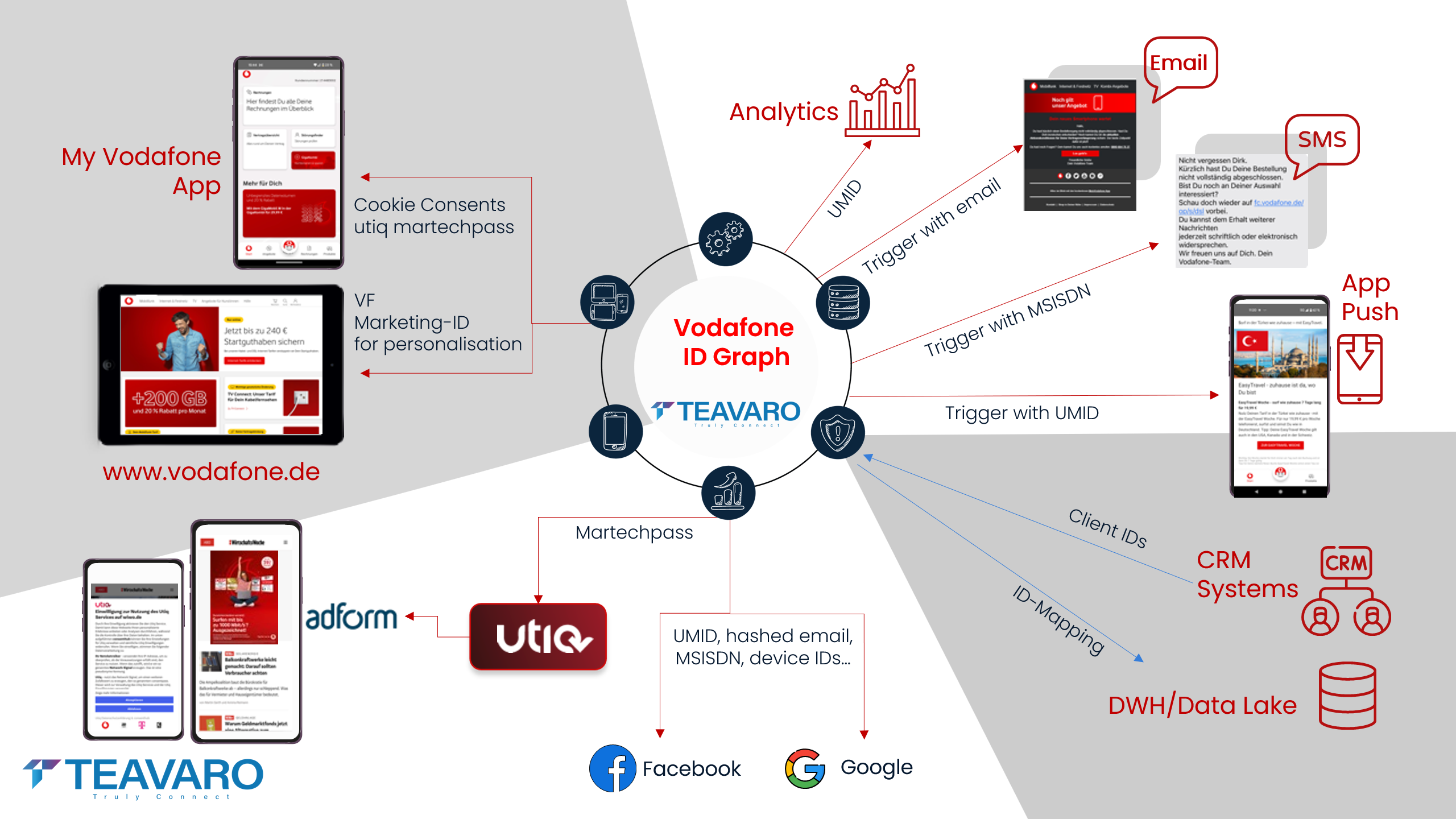
Vodafone Germany started with the same challenge: siloed customer data, fragmented MarTech tools, and limited actionability of data across own media. They rolled out Teavaro’s Marketing Identity Activation Hub across all channels and ...

  • Reached 3.75 times larger customer audience match in Safari and Firefox.
  • Delivered real-time personalisation across vodafone.de, app and email.
  • Enabled behavioural event-triggeted emails from non-logged-in sessions.
  • Leveraged mobile and fixed network identification with login and click identification to maximise the customer reach across web and app.
  • Passed UMID into MarTech solutions from Tealium to Adobe Experience Cloud for unified customer view.
  • Included integration with Pega Marketing to inline Next Best Action for Adobe Target delivered offers and event trigger based sms, email, and app push notifications.
  • Built GDPR-compliant consent controls directly into the identity fabric.

vf_integration_case


Four steps to unlock value.

1. Real-Time Identity & Analytics

Your infrastructure already knows who’s online. By using this Network ID (e.g. hashed MSISDN) through mobile header enrichment and linking it to a Unified Marketing ID (UMID), you can:

  • Resolve identities across sessions, browsers and apps.
  • Unify data across VMO2’s web and app inventory.
  • Establish a persistent User ID across Google Analytics, Floodlight, CDP, and DWH systems not just for logged in users, but everyone.

Try this: Start with a question - “Which households engage across broadband and mobile?” - and run a test in your existing dashboards.

2. Data Enrichment & Personalisation

Use your own signals - region, network type, usage, router ID - to enrich every user session:

  • Show relevant offers to SIM-only users visiting broadband pages.
  • Suppress upgrade pop-ups for existing bundle users.
  • Adapt web content in real time based on user type, geography or engagement.

Quick win: Pick three behaviours - location, product depth, recency - and test their impact on homepage conversion.

3. Email & App Activation

Your emails and apps already do heavy lifting. Now they can work together, powered by a Unified Identity:

  • Link email clicks or app sessions to web behaviour before login.
  • Trigger recovery emails and push notifications on unknown browsers.
  • Throttle sends based on on-site activity to avoid over-messaging.
  • Maintain a profile link to customers when not logged in or on mobile connection using first party cookie not affected by browser restrictions or ad blockers.

Start here: Choose one journey - renewal, abandonment, upsell - and measure the delta when identity is in place.

4. Paid Media Efficiency

UMID-based segments let you reduce waste and boost reach across beyond third party cookie sync and customer data matching:

  • Suppress recent customers from awareness campaigns.
  • Achieve significantly higher match rates in Safari and Firefox.
  • Retarget lookalikes based on your best users.

Pilot idea: Run a suppression test against Volt users and reinvest the savings into top-decile lookalikes.

Trusted by:

Strengthen CVM performance by:


  • Assessing the percentage of the base currently reachable in campaigns.

  • Identifying where network identity can extend reach.

  • Prioritising use cases such as churn prevention, upsell, and paid media efficiency.

With Teavaro, real-time IDR including network identity becomes the foundation for consistent engagement across the entire subscriber base - reframing CVM as a driver of customer engagement, and long-term customer value creation.

What's next?


  1. Start with one sharp question: for example, “How do we stop reacquiring existing mobile customers?”
  2. Audit your signals and gaps: consented MSISDN, mobile IPs, router IDs, declared emails, app sessions, first-party cookies, and where consent is stored.
  3. Enable the UMID: unify IDs across web, app, and network. Keep matching rules simple, logged, and auditable.
  4. Run a six-week test on one KPI: for example, paid suppression or win-back frequency. Include holdouts and measure net lift and cost savings.
  5. Scale what works: extend to new journeys and channels, feed the UMID into your CDP and media platforms, add insight loops, and automate.


Build a common identity foundation to maximise customer engagement, marketing impact, and unlock data monetisation and collaboration opportunities.

Explore more at https://teavaro.com/ or contact sibilla.ponzoni@teavaro.com to talk options.